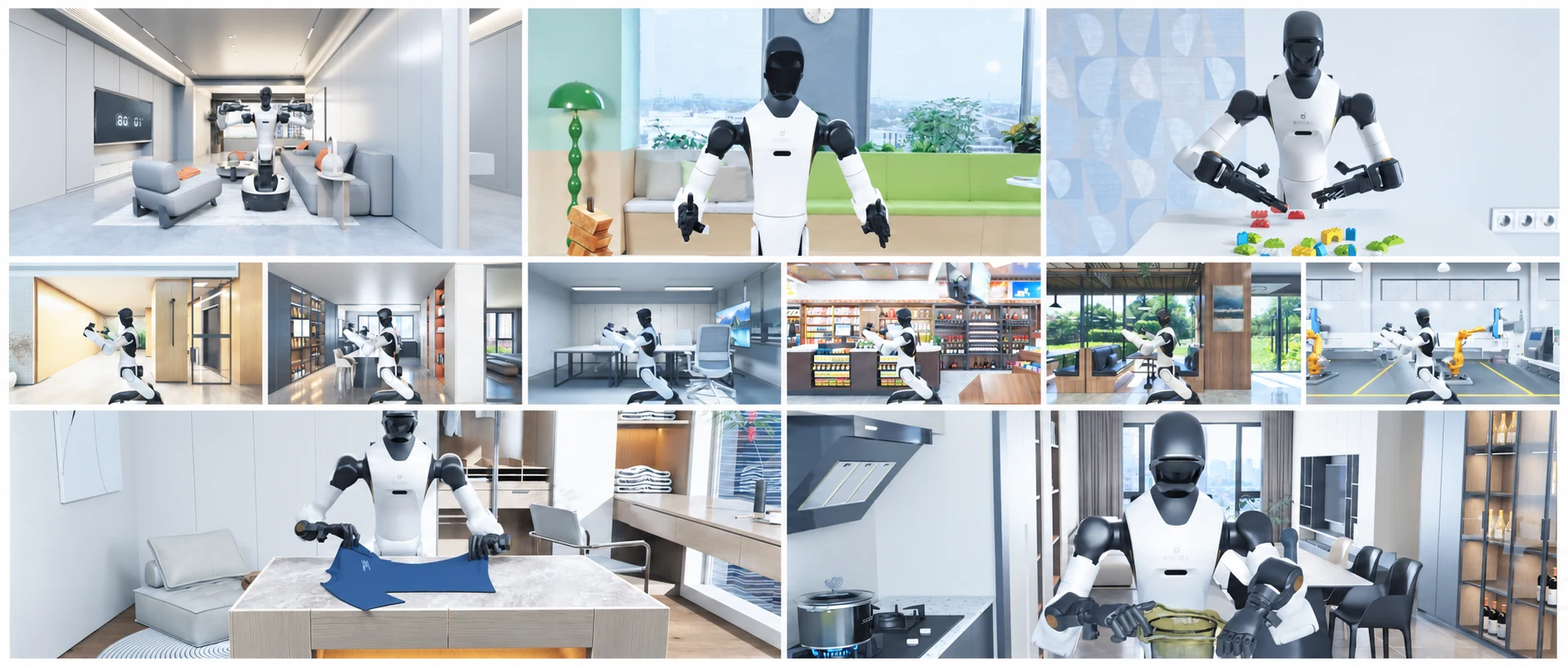
家居
RESEARCH OVERVIEW研究概述
Abstract摘要
This report presents the Genie Sim Platform, an integrated simulation platform for embodied intelligence that brings together simulation, data collection, evaluation, and model improvement. It describes robot and object system identification and control calibration for sim–real consistency; composable physics and rendering engines supporting rigid and deformable interactions; teleoperation and automated data collection; and multidimensional benchmarking across robot embodiments. The platform further supports reinforcement-learning post-training through RLinf, open-world environments for next-generation embodied-agent evaluation, and action-conditioned visual simulation through Genie Sim Dream. Experiments examine the reliability of Genie Sim through paired real–simulation comparisons, assess agents on four new task suites, and report reinforcement-learning and closed-loop world-model results. Together, these components establish a workflow from simulation construction and physical alignment to capability assessment and policy improvement, supporting the co-evolution of simulation, evaluation, and embodied models.本报告介绍Genie Sim 平台,系统阐述这一面向具身智能、集仿真、数据采集、评测与模型改进于一体的平台的组件与功能。报告涵盖旨在提升虚实一致性的机器人与物体系统辨识及控制校准、支持刚柔交互的可组合物理和渲染引擎、遥操作与自动化数据采集,以及覆盖不同机器人本体的多维能力评测。平台进一步通过 RLinf 支持强化学习后训练,以开放世界环境支持面向下一代具身 Agent 的仿真评测,并通过 Genie Sim Dream 实现动作条件下的视觉仿真。实验部分通过真实—仿真配对比较检验 Genie Sim 的可靠性,报告 Agent 在四类新增任务套件上的评测表现,以及强化学习和世界模型闭环实验结果。上述组件共同形成从仿真构建与物理对齐,到能力评测与策略改进的完整流程,支持仿真、评测与具身模型的协同进化。
CHAPTER 01
Simulation, evaluation, and evolution仿真、评测与进化
1.1从物理对齐到模型改进
Genie Sim 将系统辨识、可组合的物理和渲染引擎,以及多维能力评测连接起来。遥操作与自动采集提供交互数据。RLinf 通过强化学习后训练优化策略,Genie Sim Dream 则利用世界模型生成机器人交互中的视觉观测。这些模块共同围绕模型的研发与迭代展开。
物理一致性的惯性辨识约束机器人参数估计,RigPI 则结合视觉语言先验、力与力矩观测及运动信息进行物体辨识。Genie Sim 将动力学、接触与控制校准连接到真实—仿真配对评测,以检验任务层面的虚实一致性。
1.2随模型共同演进的评测
Genie Sim 3.0 的指令遵循、空间推理、通用操作与抗扰动四个 track,是基于特定发展阶段的具身模型能力水平及算法研究重点设计的,旨在从指令条件下的交互、空间关系推理、物体操作与环境变化适应等方面,对模型的基础能力进行结构化评估。
随着模型能力提升,制约性能的主要瓶颈和算法优化的重点也会发生变化。评测体系需要与模型和算法的演进协同更新,才能持续区分模型能力、识别尚未解决的局限,并为后续迭代提供依据。因此,逐步扩展任务结构与能力覆盖,是保持评测诊断价值和研究指导作用的必要条件。
扩展后的 benchmark 在保留原有 track 的基础上,新增灵巧手操作、全身协同、精细操作与跨本体操作四类任务套件,分别考察手指功能性协同、底盘—躯干—机械臂联合控制、精细几何对齐,以及操作能力的跨本体迁移,从而为评估持续发展的具身模型提供更充分的实证基础。
1.1From physical alignment to model improvement
Genie Sim connects system identification, composable physics and rendering engines, and multidimensional evaluation. Teleoperation and automated collection provide interaction data. RLinf supports reinforcement-learning post-training for policy optimization; Genie Sim Dream uses a world model to generate visual observations of robot interactions. Together, these modules support embodied-model research, development, and iterative improvement.
Physically consistent inertial identification constrains robot parameter estimates, while RigPI combines vision-language priors with force–torque and motion observations for object identification. Genie Sim connects dynamics, contact, and control calibration with paired real–simulation evaluation to assess task-level consistency.
1.2Evaluation that evolves with models
The four tracks in Genie Sim 3.0—Instruction Following, Spatial Reasoning, General Manipulation, and Robustness—were designed around the capabilities of embodied models and the principal objectives of algorithm development at a certain stage. They provide a structured assessment of foundational competencies in instruction-conditioned interaction, spatial reasoning, object manipulation, and robustness to environmental variation.
As model capabilities advance, the dominant performance bottlenecks and the objectives of algorithm development also change. Evaluation must evolve in concert with these developments to maintain its ability to distinguish model capabilities, identify unresolved limitations, and provide evidence for subsequent iterations. Extending task structures and capability coverage is therefore necessary for evaluation to remain informative throughout model development.
The expanded benchmark complements the established tracks with Dexterous-Hand Manipulation, Whole-Body Coordination, Precision Manipulation, and Cross-Embodiment Manipulation. These suites assess functional finger coordination, integrated base–body–arm control, fine geometric alignment, and transfer of manipulation capabilities across robot embodiments, broadening the empirical basis for evaluating increasingly capable embodied models.
CHAPTER 02
System identification and Real2Sim系统辨识与 Real2Sim
仿真的基础是尽可能真实地复现现实世界中的物理交互。仿真评测首先需要回答的核心问题是,被测模型在仿真中的表现能在多大程度上反映其在真实机器人上的表现。为此,我们开展机器人与物体的系统辨识及控制校准工作,以提升虚实一致性,并通过 Real2Sim 实验检验 Genie Sim 的可靠性。
切换阅读主题回放协议
2.1记录指令回放
回放的目标是复现给定指令下机器人与物体的响应。x 包含其构型与速度,u 表示记录的关节及夹爪目标;动力学与视觉观测分别建模:
状态演化
视觉观测
ℰ 指物理后端,θr、θo 分别为机器人与物体参数,ψ 为控制和积分设置,η 为观测标定。图像点与 RGB-D 特征估计不是对完整物理状态的直接测量,因此机器人动力学、物体交互和执行设置需要分开表述。
每项对比明确机器人本体、末端执行器、交互资产、初始状态和指令接口。G2 物体回放实验以约 100 Hz 保持记录的关节及夹爪位置目标,物理子步为 1 ms。物体运动由动力学和接触产生,不使用抓取绑定或逐帧替换物体位姿。
2.2机器人动力学与验证
G2 crsB 双臂采用固定的电流—力矩系数 K,将电机电流 I 与刚体动力学、摩擦、阻尼、等效电枢惯量及偏置联系起来:
力矩平衡
刚体动力学
平滑摩擦
惯性参数 π 决定刚体动力学;对角矩阵 F、D、A 分别表示类库仑摩擦、黏性阻尼及等效电枢惯量。等效惯量可能吸收模型近似误差,不能视为经确认的物理转子惯量。匀速激励估计摩擦和阻尼,正弦激励在临时惯性参数下估计电枢惯量,随后固定 F、D、A,利用耦合 Fourier 激励拟合惯性与偏置。分阶段辨识减少参数间的补偿,但物理一致性约束不保证唯一恢复各连杆属性。X5 因不支持力控而采用简化模型。
力矩重建残差
无夹爪仿真在执行器限幅前采用位置 PD 控制;传感器修正仅作用于后处理,不改变物理受力或控制:
位置 PD 控制
传感器读数
Kp = 1000 I7 N·m/rad,Kd = diag(1, 5, 1, 1, 1, 1, 1) N·m·s/rad 为采用的仿真设置,并非辨识得到的硬件增益;h 表示观测器历史。电流推算力矩、仿真连杆力矩和关节侧实测反馈是不同物理量。逆动力学重建、前向预测和闭环回放分别检验不同响应;强反馈可能在模型不完善时仍压低位置误差,因此位置与未去中心化的传感器力矩 RMSE 分别报告。机器人姿态、控制器和力矩零点的来源记录仍不完整。
在 15 次长时序运行、21 个有效关节/激励单元中,位置 RMSE 为 0.035°–1.002°。位置跟踪与力矩一致性分别评估。MuJoCo/MJWarp 的一致性及同一记录内的时间检查,尚不能证明独立 episode 的泛化。
2.3物体交互及测量边界
在固定执行设置与质量先验的条件下,通过有界搜索拟合有效接触参数,并在适用时调整几何、质心和初始姿态。水壶、口香糖盒、海绵、羽毛球和笔覆盖搬运、等效柔顺接触及交接;源环境拟合、冻结参数迁移和原生适配分别报告。
观测 RMSE
拟合目标函数
𝒱 为有效观测时刻集合,三维空间中的米制误差与投影图像中的像素误差分开计算。口香糖盒和海绵的源环境拟合使用保持阶段夹爪 RMSE eg,hold;分母用于量纲归一化,不是实测噪声水平。交接采用另一 RGB/夹爪目标函数;可行性判据与观测误差共同使用,较小夹爪残差本身不能证明抓取成功。
冻结执行设置能减少但不能消除物体参数与机器人、几何、初始状态或相机误差之间的歧义;拟合的接触和阻尼值属于有效仿真参数。完整候选参数网格、掩码和选择规则仍待归档确认,已报告的目标函数本身不能证明获得全局最优。
2.4Real2Sim 实验
Real2Sim 实验覆盖 16 项任务、22 组机器人—任务配对配置,对比真实机器人与仿真中的任务表现。实验测得任务得分的 Pearson 相关系数为 0.9686,MAE 为 0.0405,RMSE 为 0.0520。各项对比沿用对应任务的 Score 定义。
Simulation aims to reproduce real-world physical interactions as faithfully as possible. A central question for simulation-based evaluation is therefore how well a model’s performance in simulation reflects its performance on a physical robot. To address this question, we conduct robot and object system identification and control calibration to improve sim–real consistency, and use Real2Sim experiments to evaluate the reliability of Genie Sim.
Explore this chapterReplay protocol
2.1Recorded-command replay
Replay aims to reproduce command-conditioned robot and object responses. Let x contain their configurations and velocities and u the recorded joint/gripper targets. Dynamics and visual observation are modeled separately:
State transition
Visual observation
ℰ selects the physics backend, θr and θo denote robot and object parameters, ψ contains control/integration settings, and η is observation calibration. Image points and RGB-D feature estimates do not directly measure the complete physical state. Robot dynamics, object interactions, and execution settings therefore retain distinct roles.
Each comparison fixes the embodiment, end effector, interacting assets, initial state, and command interface. In the G2 object-replay study, recorded joint and gripper position targets are held at approximately 100 Hz, with 1 ms physics substeps. Object motion comes from dynamics and contact, without grasp attachments or frame-wise pose replacement.
2.2Robot dynamics and validation
For the G2 crsB dual arms, a fixed current-to-effort scale K relates motor current I to rigid-body dynamics, friction, damping, effective armature, and an offset:
Torque balance
Rigid-body model
Smooth friction
The inertial parameters π determine rigid-body dynamics. Diagonal F, D, and A represent Coulomb-like friction, viscous damping, and effective armature. The latter can absorb model approximations and is not a certified physical rotor inertia. Constant-speed sweeps estimate friction/damping, sine motion estimates armature with temporary inertia, and coupled Fourier excitation then fits inertia and offsets with F, D, and A fixed. This staging limits parameter compensation; physical-consistency constraints do not guarantee unique recovery of individual link properties. X5 uses a simplified model because force control is unavailable.
Effort residual
The gripper-free simulation uses position PD control before actuator limits. Its sensor correction is postprocessing only and changes neither plant forces nor control:
Position PD control
Sensor readout
Kp = 1000 I7 N·m/rad and Kd = diag(1, 5, 1, 1, 1, 1, 1) N·m·s/rad are adopted simulation settings, rather than identified hardware gains; h denotes observer history. Current-derived effort, simulated link torque, and measured joint-side feedback are distinct quantities. Inverse-dynamics reconstruction, forward prediction, and closed-loop replay test different behaviors. Strong feedback can reduce position error even with an imperfect plant, so position and uncentred sensor-torque RMSE are reported separately. Robot posture, controller, and torque-zero provenance remain incomplete.
Across 15 long-horizon runs, position RMSE spans 0.035°–1.002° over 21 active joint/excitation cells. Position tracking and torque agreement are evaluated separately. MuJoCo/MJWarp consistency and same-recording temporal checks do not establish independent-episode generalization.
2.3Object interaction and measured limits
Bounded searches fit effective contact parameters and, where applicable, geometry, center of mass, and initial orientation, while holding execution settings and mass priors fixed. Kettle, gum box, sponge, shuttlecock, and pen cover carrying, effective compliant contact, and handover. Source fitting, fixed transfer, and native adaptation are reported separately.
Observation RMSE
Fitting objective
𝒱 contains valid observation timestamps. Three-dimensional metre errors and projected pixel errors remain separate. For gum-box and sponge source fitting, eg,hold is holding-phase gripper RMSE; the denominators normalize units and are not measured noise levels. Handover uses a different RGB/gripper objective. Feasibility gates supplement observation error, since a small gripper residual alone does not prove a successful grasp.
Frozen execution reduces but does not eliminate ambiguity with robot, geometry, initial-state, or camera error; fitted contact and damping values are effective simulation parameters. Complete candidate grids, masks, and selection rules await archival confirmation. The objectives alone do not establish a global minimum.
2.4Real2Sim experiments
The Real2Sim experiments compare real-robot and simulated task performance across 22 paired robot–task configurations spanning 16 tasks. The measured task Scores have a Pearson correlation of 0.9686, with MAE 0.0405 and RMSE 0.0520. Each comparison uses the task’s own Score definition.
CHAPTER 03
Composable physics and rendering engines可组合的物理和渲染引擎
切换阅读主题统一协议
3.1统一协议边界
GenieSim Protocol 将控制、物理状态演化与视觉观测生成分开,交换控制指令、关节状态、刚体位姿、仿真时间及形变几何更新。物理端维护状态,渲染端读取状态;场景元数据关联物理实体与视觉表示。
3.2选择物理与渲染路径
后端职责
| 组件 | 职责 |
|---|---|
| PhysX | Isaac Sim 物理执行路径 |
| Newton | 独立运行及 Isaac 集成执行 |
| libuipc | 刚柔耦合接触仿真 |
| MuJoCo | 求解器集成与协同 CPU 机器人动力学 |
| Isaac Sim / OVRTX | 通过共享状态接口提供可选渲染路径 |
适配器实现初始化、指令执行、步进、状态读取和重置。场景组装准备资产与资源清单,并执行后端专属转换。独立进程隔离依赖并支持不同更新频率;相机与外观设置可独立于物理模型选择。
3.3刚柔交互
libuipc 对布料和袋状物使用三角壳模型,对纸张折痕支持塑性弯曲,对体积软体使用稳定 Neo-Hookean 本构的四面体有限元,对刚体使用仿射体动力学。几何映射将求解位置传回原始视觉网格。
CPU MuJoCo 进程推进机器人动力学及配置的机器人—静态环境接触,连杆位姿和速度驱动 IPC,由后者推进动态任务物体及柔性接触。当前耦合是单向的:IPC 接触力不会回传 CPU 机器人模型。已有场景包括叠布、折纸、衣架操作和束口袋操作。
柔性物体交互演示抽垃圾袋
抽垃圾袋
机器人展开并操作垃圾袋,随后收拢袋口、操作抽绳,展示袋体在接触和拉伸下的形变。
静音循环 · 点击或按空格暂停
挂衣服
双手调整衣物与衣架的相对位置,展示布料在抓持和穿入衣架过程中的垂落与形变。
静音循环 · 点击或按空格暂停
叠衣服
机器人通过连续抓持和折叠动作改变衣物形态,展示桌面上的叠衣过程。
静音循环 · 点击或按空格暂停
Explore this chapterProtocol
3.1A common protocol boundary
The GenieSim Protocol separates control, physical state evolution, and visual observation generation. It exchanges control commands, joint states, rigid-body poses, simulation time, and geometry updates for deformation. Physics owns state; rendering consumes it, with scene metadata connecting physical entities to their visual representations.
3.2Select the physics and rendering path
Backend roles
| Component | Role |
|---|---|
| PhysX | Isaac Sim physics path |
| Newton | Standalone and Isaac-integrated execution |
| libuipc | Rigid–deformable contact simulation |
| MuJoCo | Solver integration and cooperating CPU robot dynamics |
| Isaac Sim / OVRTX | Alternative rendering paths over shared state interfaces |
Adapters implement initialization, command application, stepping, state readback, and reset. Scene assembly prepares assets and a resource manifest, with backend-specific conversions. Separate processes isolate dependencies and allow distinct update rates. Camera and appearance settings can be selected independently of the physical model.
3.3Rigid–deformable interaction
libuipc uses triangular shells for cloth and bags, plastic bending for paper creases, tetrahedral finite elements with a stable Neo-Hookean model for volumetric soft bodies, and affine-body dynamics for rigid objects. Geometry mappings carry solved positions back to the authored visual meshes.
A CPU MuJoCo worker advances the robot and configured robot–static-environment contacts. Link poses and velocities drive IPC, which advances dynamic task objects and deformable contact. The coupling is directional: IPC contact forces are not fed back into the CPU robot model. Supplied scenes include cloth folding, paper folding, cloth-hanger manipulation, and drawstring-bag manipulation.
Deformable interaction demonstrationsDrawstring trash bag
Drawstring trash bag
The robot opens and handles a trash bag, then gathers the opening and manipulates the drawstrings.
Muted loop · Click or press Space to pause
Clothes hanging
The hands adjust the garment around a hanger, showing how cloth drapes and changes shape during handling.
Muted loop · Click or press Space to pause
Clothes folding
Successive grasps and folds reshape the garment on the work surface.
Muted loop · Click or press Space to pause
CHAPTER 04
Teleoperation and automated data collection遥操作与自动化数据采集
切换阅读主题遥操作
4.1遥操作
PICO VR 支持双臂、腰部与移动底盘控制。控制器位姿、按键与摇杆输入被转为运动目标,经逆运动学和轨迹处理后驱动仿真机器人;动作捕捉手套提供灵巧手输入。机器人状态与多视角图像同步记录。
4.2智能体辅助自动采集
智能体根据自然语言任务检索并组合机器人、物体和环境资产,编写场景构建与任务编排脚本。资产组合、布局和初始条件的变化形成任务变体。执行时记录关节轨迹、底盘/末端位姿、物体状态、时间戳,以及适用任务中的形变与几何映射。
4.3回放、重渲染与质量控制
物理交互记录与视觉观测生成相互分离。保存的轨迹、位姿和形变状态用于重建交互;回放在指定相机、光照、背景和材质下生成多视角 RGB 与深度。episode 转换保留机器人配置、关节顺序、相机参数和来源信息。
质量控制检查数据完整性、状态值有限性、时间戳严格递增及视频帧数。任务结果与数据有效性分别记录,区分“任务完成”和“采集数据可用”。
Explore this chapterTeleoperation
4.1Teleoperation
PICO VR supports dual-arm, waist, and mobile-base control. Controller poses, buttons, and joysticks become motion targets; inverse kinematics and trajectory processing drive the simulated robot. Motion-capture gloves add dexterous-hand input. Robot states and multi-view images are recorded synchronously.
4.2Agent-assisted collection
From a natural-language task, an agent retrieves and composes robot, object, and environment assets, then writes scene-construction and task-orchestration scripts. Asset combinations, layouts, and initial conditions create task variants. Execution records joint trajectories, base/end-effector poses, object states, timestamps, and—where relevant—deformation and geometry mappings.
4.3Replay, re-rendering, and quality control
Physical interaction recording is separated from visual observation generation. Saved trajectories, poses, and deformation states reconstruct an interaction; replay generates multi-view RGB and depth with selected cameras, lighting, backgrounds, and materials. Episode conversion preserves robot configuration, joint ordering, camera parameters, and provenance.
Quality control checks completeness, finite state values, strictly increasing timestamps, and video frame counts. Task outcome and data validity are separate records, so a completed task and a valid dataset are not conflated.
CHAPTER 05
Benchmark task suitesBenchmark 任务套件
5.1基础评测 Track
已有四个 Track 评估具身模型的基础能力。指令遵循考察模型能否将语言指令转化为物体选择与操作;空间推理关注相对位置、朝向与空间关系;通用操作覆盖常见物体交互与多步骤操作;抗扰动评估外观及环境条件变化下的任务表现。
这四个 Track 为 VLA 策略、WAM 策略和模型驱动的 Agent 提供共同的比较基础。新增 Track 在此基础上进一步考察更复杂的操作能力及跨本体迁移。
5.2新增评测 Track
四类新增任务套件灵巧手
灵巧手操作
颠锅
手指持续控制锅柄,机械臂协调完成颠锅动作,展示工具抓持与多指协同。
静音循环 · 点击或按空格暂停
抓剪刀
手指接近剪刀并围绕手柄建立接触,随后从桌面提起工具,展示多指抓持与工具操作。
静音循环 · 点击或按空格暂停
叠碗
手指进入碗内并提供支撑,双手协调提起与放置,展示对碗口几何和抓持方式的适配。
静音循环 · 点击或按空格暂停
取书
机器人伸手进入书架,抓取并抽出书本,在受限空间中保持手指接触和书本朝向。
静音循环 · 点击或按空格暂停
该套件使用搭载 Wuji 灵巧手的 G2 平台,关注多指如何参与物体交互。取书、剪刀操作、双手搬运包裹、盖杯盖和叠碗共同覆盖手指构型选择、抓取后的持续操作及双手协作,将手部动作的功能性纳入评测。
剪刀操作要求同一只手的拇指和另一根手指分别进入两个手柄孔,并协调运动来驱动开合。普通平行夹爪无法复现这种入环与驱动方式。取书任务则要求在密集书架中先倾斜目标书本,再将其取出,考察接触选择与取物顺序。
包裹搬运强调双手控制同一物体;盖杯盖与叠碗连接抓取、接近、对齐和放置。任务比较有助于识别功能性抓取规划、持续操作和双手协调中的相对短板。
全身协同
捡垃圾
机器人通过移动定位与机械臂动作连接接近、抓取和收集过程,展示场景中的全身协同。
静音循环 · 点击或按空格暂停
放餐盘
机器人在运输与放置餐盘时协调身体位置和机械臂动作,连接移动与末端放置。
静音循环 · 点击或按空格暂停
传送带操作
机器人在传送带旁定位,并围绕运动中的作业区域协调操作动作。
静音循环 · 点击或按空格暂停
开门
机器人协调底盘定位与机械臂动作,连接门把操作、开门和穿过门口的过程。
静音循环 · 点击或按空格暂停
全身协同任务需要移动底盘、躯干和机械臂共同参与。底盘位置与身体构型决定可达空间,持握物体又会约束后续移动;托盘配送、垃圾收集、门交互和货架放置围绕这种耦合关系组织较长操作序列。
托盘配送连接拾取、运输与载物稳定;垃圾收集将不同地点的拾取与最终投放串联,要求跟踪进度并选择接近位置。门交互耦合底盘定位、门的开合和通行顺序,货架放置则需要身体构型适应最终目标。
这些任务考察“去哪里、以何种身体构型交互、当前操作如何衔接后续动作”的联合决策,揭示局部操作能否延伸为完整移动操作,以及运输中能否维持物体控制。
精细操作
插网线
近景展示接头接近端口以及对齐过程中的微小相对运动。
静音循环 · 点击或按空格暂停
拼积木
机器人通过接触处的细致调整对齐并拼接小部件,展示精细定位与装配过程。
静音循环 · 点击或按空格暂停
手机打包
机器人依次操作手机与包装部件,通过对齐和放置连接多个包装步骤。
静音循环 · 点击或按空格暂停
连接充电线
双手分别控制手机与接头,通过相对位置和方向调整完成充电线对接。
静音循环 · 点击或按空格暂停
精细操作关注局部几何和微小相对运动对任务完成的影响,涵盖向奶茶杯插吸管、盖笔帽、投硬币、插积木、接网线、装轴承、手机打包和连接手机充电线八类任务。孔口、接口和配合部件要求将目标理解转为适当的接近方向、对齐与动作衔接。
吸管、硬币和笔帽操作要求感知小物体与目标的相对关系。连接器对接和轴承安装强调部件方向与对齐,手机充电还需双臂分别操作手机和接头;手机打包则把精细放置嵌入手机、内包装与盒盖之间的连续流程。
通过变化配合几何、操作对象和动作序列,该维度考察细粒度空间感知、相对位姿控制、双臂对齐及多步骤装配,并帮助定位接口识别、精细对齐和后续部件关系维持等困难。
跨本体操作
挂杯子
四种机器人配置分别接近目标并挂放杯子;原始四宫格保留各画面的播放节奏。
静音循环 · 点击或按空格暂停
写字母 B
四种机器人配置沿字母 B 的轨迹书写,展示共同书写目标在不同结构上的动作实现。
静音循环 · 点击或按空格暂停
开垃圾桶扔垃圾
四宫格视频展示不同机器人配置打开垃圾桶并投放纸团的过程。
静音循环 · 点击或按空格暂停
跨本体套件在 ARX、AgileX、G1 和 G2 Omnipicker 四种配置上组织六类共同任务:开垃圾桶扔垃圾、用工具刮垃圾、挂杯子、换键帽、写字和倒水。这些任务考察模型如何根据不同机器人结构调整关节物体交互、工具使用、放置、精细操作、书写和液体转移。
运动学结构、可达空间和末端几何的差异,使同一目标需要不同动作实现。开垃圾桶扔垃圾连接开盖和投放;工具刮垃圾要求形成正确的工具—垃圾接触;挂杯子和换键帽需要适配末端与目标的接近和对齐;写字与倒水则将运动路径和物体朝向连接到交互目标。
该 track 旨在评估模型的操作能力能否在不同机器人本体之间迁移。通过在多个本体上设置相同类型的任务,考察模型能否适应运动学结构、工作空间和末端执行器的差异,在不同机器人上完成相同的操作目标。
5.3Benchmark Results
我们使用此前技术报告提出的 Agent2Act 框架 [1],接入 GPT-6 Astra、Claude Opus 5.5 和 Gemini 4 Argon 三个前沿 LLM,在灵巧手操作、全身协同、精细操作和跨本体操作四个新增 Track 上进行评测,得到如下 Score。
[1] Huang 等,Frontier LLMs Enter the World of Robotics: A Cross-Model Evaluation on RoboColiseum,技术报告,2026。arXiv:2610.27865。
横向滑动查看完整图表 ↔
三个 Agent 在四个新增任务套件上的报告 Score。平均值沿用源表;粗体标出各行最高分。
三个 Agent 的四类新增任务评测
| 任务套件 | GPT-6 Astra | Claude Opus 5.5 | Gemini 4 Argon |
|---|---|---|---|
| 精细操作 | 18.86 | 19.62 | 12.84 |
| 跨本体操作 | 16.94 | 14.61 | 12.29 |
| 全身协同 | 13.65 | 7.63 | 11.60 |
| 灵巧手操作 | 0.41 | 7.05 | 2.40 |
| 平均值 | 12.47 | 12.23 | 9.78 |
三个 Agent 在四个新增任务套件上的报告 Score。平均值沿用源表;粗体标出各行最高分。
报告中的平均 Score 为 Astra 12.47、Opus 12.23、Argon 9.78。Astra 与 Opus 的平均值仅相差 0.24,但优势分布不同:Astra 领先跨本体操作与全身协同,Opus 领先精细操作与灵巧手操作。
实验结果分析
精细操作
Opus 得分 19.62,Astra 为 18.86。报告中的逐任务分析进一步区分了两者的策略特点:Opus 在手机打包上表现更好,Astra 在盖笔帽和投硬币上领先。抓持方式、接近方向及接触调整需要适配具体物体与操作。
全身协同
Astra 以 13.65 领先,Argon 为 11.60,Opus 为 7.63。此类任务把底盘移动、身体姿态和机械臂操作连接为连续过程,要求机器人在位置和构型变化时持续控制物体。
灵巧手操作
这是三个 Agent 各自得分最低的套件:Opus 为 7.05,Argon 为 2.40,Astra 为 0.41。以剪刀操作为例,手指需要进入手柄环、建立稳定抓持,并协同完成开合。多指协同和功能性工具使用仍是主要困难。
跨本体迁移
Astra 在跨本体操作上以 16.94 领先,Opus 为 14.61,Argon 为 12.29。报告还指出,排名随机器人变化:Astra 在 G2 Omnipicker 上领先,Opus 则在 AgileX 上领先。
同一任务目标需要适配不同机器人的可达范围、末端几何与相机布局。在一个机器人上的表现无法完整预测另一个机器人上的表现;套件总体得分与具体本体上的行为共同为模型选择和本体适配提供依据。
5.4开放世界 Genie Sim Sandbox
开放世界仿真环境面向下一代具身智能的仿真与评测,将导航、环境交互与物体操作融入多样化场景和多阶段任务,用于考察智能体完成复杂任务的综合能力。
示例覆盖家居、便利店、餐厅、酒店与办公室五个典型场景。
场景浏览 · 每页五个任务家居
家居
收杯碗
1:16家居
整理沙发
0:27家居
开卧室门
2:34家居
碗入柜
2:00便利店
取果汁
0:20便利店
搬纸箱
0:45便利店
果汁归架
0:30便利店
投放垃圾
1:14便利店
筐归垛
1:15餐厅
换餐盘
0:39餐厅
收水杯
0:35餐厅
送果汁
0:33餐厅
托盘送餐
2:25餐厅
引导入座
0:23酒店
丢纸团
0:29酒店
放雨伞
0:32酒店
搬行李
0:24酒店
送可乐
0:46酒店
整理候客区
0:44办公室
推入椅子
0:30办公室
清理废纸
1:43办公室
补笔
1:18办公室
递文件夹
1:10办公室
补水
1:485.1Foundational evaluation tracks
The four established tracks assess foundational capabilities of embodied models. Instruction Following evaluates how models translate language instructions into object selection and actions; Spatial Reasoning examines relative positions, orientations, and spatial relationships; General Manipulation covers common object interactions and multi-step operations; and Robustness evaluates performance under variations in visual appearance and environmental conditions.
These tracks provide a shared basis for comparing VLA policies, WAM policies, and model-driven agents. The new tracks extend this foundation to more demanding forms of manipulation and embodiment transfer.
5.2New evaluation tracks
Four new task suitesDexterous hand
Dexterous-Hand Manipulation
Wok tossing
Finger motion maintains the pan hold while the arms coordinate a tossing motion.
Muted loop · Click or press Space to pause
Scissors grasping
The fingers approach the scissors, establish contact around the handle, and lift the tool from the desk.
Muted loop · Click or press Space to pause
Bowl stacking
The fingers enter and support the bowl while the hands coordinate lifting and placement over another bowl.
Muted loop · Click or press Space to pause
Book retrieval
The robot reaches into a shelf, grasps a book, and withdraws it while maintaining finger contact and orientation.
Muted loop · Click or press Space to pause
This suite uses the G2 platform equipped with Wuji dexterous hands to examine how multiple fingers participate in object interaction. Book retrieval, scissors operation, bimanual parcel transport, cup lidding, and bowl stacking require different combinations of finger configuration, manipulation after grasping, and hand coordination. These tasks extend evaluation to the functional role of hand motion within an interaction.
Scissors operation makes this requirement explicit. The thumb and another finger of the same hand enter separate handle holes and coordinate their motion to open and close the scissors. A conventional parallel-jaw gripper cannot reproduce this finger-in-hole operating pattern. The task examines whether a model can infer how to use the tool, form an appropriate hand configuration, and drive its motion while maintaining the hold. Book retrieval instead begins with a constrained workspace: the robot tilts a book within a tightly arranged shelf before extracting it, linking contact selection to the sequence needed to create removal space.
The remaining tasks broaden the coordination demands. Parcel transport requires both hands to control one object, while cup lidding and bowl stacking connect grasp configuration to subsequent approach, alignment, and placement. Comparing these interactions helps identify relative weaknesses in functional grasp planning, sustained manipulation, and bimanual coordination.
Whole-Body Coordination
Trash collection
Mobile positioning and arm motion connect reaching, retrieval, and trash collection across the scene.
Muted loop · Click or press Space to pause
Plate placement
The robot coordinates body positioning and arm motion while transporting and placing plates.
Muted loop · Click or press Space to pause
Conveyor interaction
The robot positions itself beside a conveyor and coordinates manipulation with the moving work area.
Muted loop · Click or press Space to pause
Door opening
Base positioning and arm motion guide handle operation, door opening, and passage through the doorway.
Muted loop · Click or press Space to pause
Whole-body tasks extend evaluation to interactions that require the mobile base, torso, and arms to work together. Base position and body posture determine the reachable workspace, while a held object constrains subsequent movement. Tray delivery, trash collection, door interaction, and shelf placement are designed around this coupling over extended action sequences.
Tray delivery connects pickup and transport to maintaining the load during motion. Trash collection links retrieval from different locations to eventual disposal, requiring the model to track progress and choose suitable approach positions. Door interaction couples base placement, articulated-object manipulation, and the order of passage and closing. Shelf placement requires body configuration to adapt to the destination while connecting transport to final placement.
These tasks examine the joint decisions of where to move, how to position the body for interaction, and how to connect the current operation to later actions. They help reveal whether local manipulation skills extend to complete mobile sequences, whether object control is maintained during transport, and whether approach, interaction, and departure form a coherent plan.
Precision Manipulation
Ethernet connection
A close view follows the connector approaching its port and the small relative motions used for alignment.
Muted loop · Click or press Space to pause
Block assembly
The robot aligns small parts and joins the blocks through controlled adjustments at the contact interface.
Muted loop · Click or press Space to pause
Phone packaging
The robot handles the phone and packaging components through a sequence of aligned placements.
Muted loop · Click or press Space to pause
Phone charging
The hands coordinate phone positioning and connector alignment before inserting the charging cable.
Muted loop · Click or press Space to pause
Precision tasks focus on interactions in which local geometry and small relative motions affect completion. The suite covers eight task categories: inserting a straw into a milk-tea cup, capping a pen, depositing a coin, inserting a block, connecting an Ethernet cable, installing a bearing, packaging a phone, and connecting a phone charging cable. Apertures, ports, and mating parts require task understanding to translate into suitable approach directions, alignment, and action transitions.
The tasks cover three recurring demands. Straw insertion, coin deposition, and pen capping require perception of a small object relative to its target and selection of an appropriate approach. Connector mating and bearing installation emphasize orientation and alignment between parts; phone charging additionally requires the two arms to handle the phone and connector separately. Phone packaging embeds precise placement within a sequence involving the phone, internal packaging components, and box lid.
Varying mating geometry, manipulated objects, and action sequences examines fine-grained spatial perception, relative-pose control, bimanual alignment, and sequential assembly. Task comparisons help identify where execution becomes difficult: locating the target interface, converting an approach into fine alignment, or maintaining established part relationships through subsequent operations.
Cross-Embodiment Manipulation
Cup hanging
Four robot configurations approach and hang a cup. The supplied montage preserves each panel’s timing.
Muted loop · Click or press Space to pause
Writing the letter B
Four robot configurations trace the letter B, showing how a common writing goal uses different action realizations.
Muted loop · Click or press Space to pause
Trash-bin opening and disposal
The four-panel recording follows bin opening and paper disposal across robot configurations.
Muted loop · Click or press Space to pause
The cross-embodiment suite places shared task intentions on ARX, AgileX, G1, and G2 Omnipicker configurations. Six shared tasks cover opening a trash bin and disposing of trash, scraping trash into a bin with a tool, hanging a cup, replacing a keycap, writing, and pouring water. They examine how models adapt articulated-object interaction, tool use, placement, fine manipulation, writing, and liquid transfer to different robot structures.
Differences in kinematic structure, reachable workspace, and end-effector geometry require different action realizations for a shared goal. Opening a trash bin and disposing of trash connects lid manipulation to subsequent placement. Tool-assisted scraping requires robot motion to produce the intended contact between the tool and trash. Cup hanging and keycap replacement require approaches and alignment compatible with the end effector and target geometry. Writing and pouring water connect motion paths and object orientation to the intended interaction.
This track evaluates whether a model’s manipulation capabilities transfer across robot embodiments. By instantiating the same task categories on multiple robots, it examines whether the model can adapt to differences in kinematic structure, workspace, and end-effectors while achieving the same task goals.
5.3Benchmark Results
Using the Agent2Act framework [1], we connect three frontier LLMs—GPT-6 Astra, Claude Opus 5.5, and Gemini 4 Argon—and evaluate them on the four new tracks: Dexterous-Hand Manipulation, Whole-Body Coordination, Precision Manipulation, and Cross-Embodiment Manipulation. The resulting Scores are reported below.
[1] Huang et al. Frontier LLMs Enter the World of Robotics: A Cross-Model Evaluation on RoboColiseum. Technical report, 2026. arXiv:2610.27865.
Swipe horizontally to see the full chart ↔
Reported Scores for three agents on four new task suites. Average follows the source table; bold marks the highest value in each row.
Three agents across four new task suites
| Task suite | GPT-6 Astra | Claude Opus 5.5 | Gemini 4 Argon |
|---|---|---|---|
| Precision Manipulation | 18.86 | 19.62 | 12.84 |
| Cross-Embodiment Manipulation | 16.94 | 14.61 | 12.29 |
| Whole-Body Coordination | 13.65 | 7.63 | 11.60 |
| Dexterous-Hand Manipulation | 0.41 | 7.05 | 2.40 |
| Average | 12.47 | 12.23 | 9.78 |
Reported Scores for three agents on four new task suites. Average follows the source table; bold marks the highest value in each row.
The reported average Scores are 12.47 for Astra, 12.23 for Opus, and 9.78 for Argon. Astra and Opus differ by only 0.24 in the average, while leading different suites: Astra leads cross-embodiment manipulation and whole-body coordination; Opus leads precision and dexterous-hand manipulation.
Experimental results analysis
Precision manipulation
Opus scores 19.62 and Astra 18.86. The report’s task-level analysis distinguishes their strategies: Opus performs better on phone packaging, while Astra leads on pen capping and coin placement. Suitable grasps, approach directions, and contact adjustments must match the object and operation.
Whole-body coordination
Astra leads with 13.65, followed by Argon at 11.60 and Opus at 7.63. These tasks connect base movement, body posture, and arm actions across successive stages, requiring the robot to maintain object control as its position and configuration change.
Dexterous-hand manipulation
This is the lowest-scoring suite for all three agents: Opus reaches 7.05, Argon 2.40, and Astra 0.41. Tasks such as operating scissors require fingers to enter the handle loops, establish a stable grasp, and coordinate opening and closing. Finger coordination and functional tool use remain difficult even when the task goal is understood.
Cross-embodiment transfer
Astra leads cross-embodiment manipulation with 16.94, followed by Opus at 14.61 and Argon at 12.29. The report also identifies a robot-dependent ranking: Astra leads on G2 Omnipicker, while Opus leads on AgileX.
The same task goal calls for actions suited to each robot’s reach, end-effector geometry, and camera layout. A model’s performance on one robot therefore does not fully predict its performance on another; suite-level scores and robot-specific behavior provide complementary evidence for model selection and embodiment adaptation.
5.4Genie Sim Sandbox
The open-world environments provide a simulation and evaluation setting for next-generation embodied intelligence. They combine navigation, environmental interaction, and object manipulation in diverse scenes and multi-stage tasks to assess agents’ ability to complete complex tasks.
The examples cover five representative settings: homes, convenience stores, restaurants, hotels, and offices.
Explore environments · five tasks per tabHome
Home
Breakfast
1:05Home
Clear tableware
1:16Home
Tidy sofa
0:27Home
Open doors
2:34Home
Store bowls
2:00Store
Fetch juice
0:20Store
Carry box
0:45Store
Restock juice
0:30Store
Dispose of trash
1:14Store
Stack baskets
1:15Restaurant
Replace plate
0:39Restaurant
Clear cups
0:35Restaurant
Deliver juice
0:33Restaurant
Serve meal
2:25Restaurant
Guide guests
0:23Hotel
Dispose of paper
0:29Hotel
Place umbrella
0:32Hotel
Handle luggage
0:24Hotel
Deliver cola
0:46Hotel
Tidy lounge
0:44Office
Tuck chairs
0:30Office
Clear paper
1:43Office
Refill pens
1:18Office
Deliver folder
1:10Office
Refill water
1:48CHAPTER 06
Reinforcement-learning post-training强化学习后训练
6.1仿真即服务
仿真服务设计系统架构
轻量客户端通过步进、重置、任务初始化、元数据和生命周期接口连接独立仿真服务。同机使用共享内存,跨机使用压缩网络传输;一个动作块通过一次往返交换,成功判定与渲染重叠执行。分离式与融合式部署共享客户端接口。
拓扑分组与超集场景支持兼容任务在重置时切换。逐环境重置恢复缓存的稳定状态;每次重置可以精确复现记录的初始状态,也可以按该环境独立的 seed 施加确定性扰动。独立随机流控制场景、机器人、环境和渲染因素,使重置结果不依赖其他环境的 episode 调度。
Rollout 效率遵循两项原则:仅计算策略与奖励实际使用的信息,并让仿真与策略推理并行保持运行。
交互层。通过动作块摊薄通信开销;仅需下一次观测时,只渲染动作块末帧。按模型需求配置分辨率,并在跨机传输时按环境并行压缩图像。
计算层。成功判定按 benchmark 的评估间隔执行,无需每个控制步重复计算;仅依赖已加载场景的静态任务信息计算一次,直至场景改变后再更新。
调度层。通过训练框架的 rollout 循环,将共享 GPU 的多个仿真服务流水化运行。一个服务等待下一次动作预测时,另一个服务执行动作块,使仿真与策略推理重叠。报告描述了该机制,未给出实测加速比。
面向后训练的并行仿真
原始录像展示多个仿真环境并行运行;训练设置与测得的收益见下文。
静音循环 · 点击或按空格暂停
6.2训练设置
OpenPI π₀.₅ 使用 GenieSim-Dataset 指令与鲁棒性套件的 5,000 条示范轨迹进行 SFT,训练 45,000 步,动作块长度为 10。PPO 后训练仅更新 action expert,在 Agibot G2 上比较单任务及 4、6、10 任务 PPO,评测涵盖十个指令遵循任务。
6.3任务收益与多任务覆盖
查看后训练结果平均表现
横向滑动查看完整图表 ↔
平均值沿用源报告表格;源稿未报告 GRPO 的十任务平均值。
报告中的任务平均成功率(%)
| 任务/模型 | 平均成功率 |
|---|---|
| 单任务 PPO | 70.95 |
| 10 任务 PPO | 67.47 |
| 4 任务 PPO | 65.79 |
| 6 任务 PPO | 62.20 |
| SFT | 51.25 |
平均值沿用源报告表格;源稿未报告 GRPO 的十任务平均值。
横向滑动查看完整图表 ↔
十个指令遵循任务的成功率(%)。GRPO 仅报告六项;缺省柱条与 — 均表示未报告,不代表零分。训练任务归属见详细表格。
GRPO 与 PPO 逐任务结果(%)
| 任务/模型 | SFT | 单任务 GRPO | 单任务 PPO | 4 任务 PPO | 6 任务 PPO | 10 任务 PPO |
|---|---|---|---|---|---|---|
| 按颜色选积木 | 71.00 | 94.00 | 96.00 | 97.00 | 84.00 | 95.00 |
| 按大小选积木 | 60.00 | 85.00 | 92.00 | 92.00 | 88.00 | 92.00 |
| 按颜色选台球 | 66.00 | 91.00 | 93.00 | 91.00 | 82.00 | 89.00 |
| 按形状选积木 | 32.00 | 37.00 | 45.00 | 37.00 | 37.00 | 41.00 |
| 选择指定物体 | 64.00 | 70.00 | 85.00 | 75.00 | 81.00 | 83.00 |
| 按类别选物体 | 50.00 | 60.00 | 65.00 | 64.00 | 63.00 | 64.00 |
| 遵循逻辑或指令 | 56.00 | — | 80.00 | 76.00 | 71.00 | 78.00 |
| 按数量选积木 | 50.47 | — | 63.55 | 58.88 | 57.01 | 61.68 |
| 常识选物 | 47.00 | — | 65.00 | 53.00 | 51.00 | 53.00 |
| 摆正物体 | 16.00 | — | 25.00 | 14.00 | 8.00 | 18.00 |
十个指令遵循任务的成功率(%)。GRPO 仅报告六项;缺省柱条与 — 均表示未报告,不代表零分。训练任务归属见详细表格。
不同训练设置下的任务成功率(%)
| 任务 | SFT 基线 | 单任务强化学习 | 多任务 PPO | |||
|---|---|---|---|---|---|---|
| SFT | GRPO | PPO | 4 任务 | 6 任务 | 10 任务 | |
| 按颜色选积木 | 71.00 | 94.00 | 96.00 | 97.00† | 84.00† | 95.00† |
| 按大小选积木 | 60.00 | 85.00 | 92.00 | 92.00† | 88.00† | 92.00† |
| 按颜色选台球 | 66.00 | 91.00 | 93.00 | 91.00† | 82.00† | 89.00† |
| 按形状选积木 | 32.00 | 37.00 | 45.00 | 37.00† | 37.00† | 41.00† |
| 选择指定物体 | 64.00 | 70.00 | 85.00 | 75.00 | 81.00† | 83.00† |
| 按类别选物体 | 50.00 | 60.00 | 65.00 | 64.00 | 63.00† | 64.00† |
| 遵循逻辑或指令 | 56.00 | — | 80.00 | 76.00 | 71.00 | 78.00† |
| 按数量选积木 | 50.47 | — | 63.55 | 58.88 | 57.01 | 61.68† |
| 常识选物 | 47.00 | — | 65.00 | 53.00 | 51.00 | 53.00† |
| 摆正物体 | 16.00 | — | 25.00 | 14.00 | 8.00 | 18.00† |
| 平均值 | 51.25 | — | 70.95 | 65.79 | 62.20 | 67.47 |
粗体标出每行已报告的最高值。† 表示该任务属于对应的多任务训练组合。— 为未报告,平均值沿用源报告。
更新后的表格还报告了单任务 GRPO 在积木颜色、尺寸、台球颜色、积木形状、指定物体和物体类别六项任务上的成功率,依次为 94.00%、85.00%、91.00%、37.00%、70.00% 和 60.00%。其余四项任务及十任务平均值未报告。
训练组合之外的相似任务也可能受益,但差异较大的任务可能退化。例如,摆正物体从 SFT 的 16.00% 降至 4、6 任务组合的 14.00% 和 8.00%,在被纳入 10 任务训练后达到 18.00%。
6.1Simulation as a service
Simulation service designArchitecture
A lightweight client connects training to a standalone simulation server through stepping, reset, task initialization, metadata, and lifecycle interfaces. Shared memory supports local transfer; compressed network transport supports cross-machine operation. An action chunk is exchanged in one round trip, while success checking overlaps with rendering. Split and fused deployments share the client interface.
Topology groups and superset scenes enable compatible tasks to switch at reset. Per-environment resets restore cached settled states; each reset either exactly reproduces the recorded initial state or applies a deterministic perturbation from its own environment seed. Independent random streams vary scene, robot, environment, and rendering factors, keeping resets reproducible regardless of other environments’ episode scheduling.
Rollout efficiency follows two principles: compute only what the policy and reward consume, and keep simulation and policy inference busy at the same time.
Interaction. Exchange action chunks to amortize communication. When only the next observation is needed, render the final frame of each chunk. Configure resolution for model needs and parallelize cross-machine image compression over environments.
Computation. Run success checking at the benchmark’s evaluation interval rather than every control step. Compute scene-dependent static task information once and reuse it until the loaded scene changes.
Scheduling. Pipeline multiple simulation servers sharing a GPU through the training framework’s rollout loop. While one server awaits its next action prediction, another executes its action chunk, overlapping simulation with policy inference. The report describes the mechanism without a measured speedup claim.
Parallel simulation for post-training
Multiple simulation environments execute alongside one another in the supplied recording. Training settings and measured gains are reported in the sections below.
Muted loop · Click or press Space to pause
6.2Training setup
OpenPI π₀.₅ is initialized with SFT on 5,000 demonstrations from GenieSim-Dataset’s instruction-and-robustness suite, for 45,000 steps and an action-chunk length of 10. PPO post-training updates only the action expert. Single-task and 4-, 6-, and 10-task PPO are compared on Agibot G2 across ten Instruction Following tasks.
6.3Task-specific gains and multi-task coverage
Inspect post-training resultsAverage
Swipe horizontally to see the full chart ↔
Averages reproduced from the source table. No ten-task GRPO average is reported.
Reported average task success (%)
| Task / Model | Average success |
|---|---|
| Single-task PPO | 70.95 |
| 10-task PPO | 67.47 |
| 4-task PPO | 65.79 |
| 6-task PPO | 62.20 |
| SFT | 51.25 |
Averages reproduced from the source table. No ten-task GRPO average is reported.
Swipe horizontally to see the full chart ↔
Success rates (%) on ten Instruction Following tasks. GRPO is reported for six tasks only; absent bars and — mean unreported, not zero. Training membership is identified in the detailed table.
GRPO and PPO results by task (%)
| Task / Model | SFT | Single-task GRPO | Single-task PPO | 4-task PPO | 6-task PPO | 10-task PPO |
|---|---|---|---|---|---|---|
| Select a block by color | 71.00 | 94.00 | 96.00 | 97.00 | 84.00 | 95.00 |
| Select a block by size | 60.00 | 85.00 | 92.00 | 92.00 | 88.00 | 92.00 |
| Select a billiard ball by color | 66.00 | 91.00 | 93.00 | 91.00 | 82.00 | 89.00 |
| Select a block by shape | 32.00 | 37.00 | 45.00 | 37.00 | 37.00 | 41.00 |
| Select the specified object | 64.00 | 70.00 | 85.00 | 75.00 | 81.00 | 83.00 |
| Select an object by type | 50.00 | 60.00 | 65.00 | 64.00 | 63.00 | 64.00 |
| Follow a logical OR instruction | 56.00 | — | 80.00 | 76.00 | 71.00 | 78.00 |
| Select the requested number of blocks | 50.47 | — | 63.55 | 58.88 | 57.01 | 61.68 |
| Select using common sense | 47.00 | — | 65.00 | 53.00 | 51.00 | 53.00 |
| Straighten an object | 16.00 | — | 25.00 | 14.00 | 8.00 | 18.00 |
Success rates (%) on ten Instruction Following tasks. GRPO is reported for six tasks only; absent bars and — mean unreported, not zero. Training membership is identified in the detailed table.
Task success by training setting (%)
| Task | SFT baseline | Single-task RL | Multi-task PPO | |||
|---|---|---|---|---|---|---|
| SFT | GRPO | PPO | 4 tasks | 6 tasks | 10 tasks | |
| Select a block by color | 71.00 | 94.00 | 96.00 | 97.00† | 84.00† | 95.00† |
| Select a block by size | 60.00 | 85.00 | 92.00 | 92.00† | 88.00† | 92.00† |
| Select a billiard ball by color | 66.00 | 91.00 | 93.00 | 91.00† | 82.00† | 89.00† |
| Select a block by shape | 32.00 | 37.00 | 45.00 | 37.00† | 37.00† | 41.00† |
| Select the specified object | 64.00 | 70.00 | 85.00 | 75.00 | 81.00† | 83.00† |
| Select an object by type | 50.00 | 60.00 | 65.00 | 64.00 | 63.00† | 64.00† |
| Follow a logical OR instruction | 56.00 | — | 80.00 | 76.00 | 71.00 | 78.00† |
| Select the requested number of blocks | 50.47 | — | 63.55 | 58.88 | 57.01 | 61.68† |
| Select using common sense | 47.00 | — | 65.00 | 53.00 | 51.00 | 53.00† |
| Straighten an object | 16.00 | — | 25.00 | 14.00 | 8.00 | 18.00† |
| Average | 51.25 | — | 70.95 | 65.79 | 62.20 | 67.47 |
Bold marks the highest reported value in each row. † denotes tasks in the corresponding multi-task training mix. — means unreported; averages follow the source table.
The updated table also reports single-task GRPO on six tasks: color, size, billiard color, shape, specified object, and object type. Their success rates are 94.00%, 85.00%, 91.00%, 37.00%, 70.00%, and 60.00%, respectively. GRPO results for the other four tasks and the ten-task average are unreported.
Related tasks outside a training mixture can benefit, while less similar tasks may decline. Object straightening, for example, drops from 16.00% SFT success to 14.00% and 8.00% in the 4- and 6-task mixtures, and reaches 18.00% when included in the 10-task mixture.
CHAPTER 07
Genie Sim Dream: World-model simulationGenie Sim Dream:世界模型仿真
切换阅读主题世界模型
7.1动作条件视觉仿真
Genie Sim Dream 基于真实 G1/G2 交互数据对 Cosmos3 进行监督微调,通过连续生成窗口的自回归训练、本体标识及机器人专属动作接口实现适配,支持开环回放与闭环策略评测的多视角视觉观测生成。
rollout 从多视角观测、任务指令和机器人状态开始。策略预测动作块,世界模型生成对应视觉序列,其末帧成为下一次策略输入;接口维护指令关节状态估计。扩展任务或本体仍需要适当交互数据、兼容动作接口及完成判据。
7.2实验配置
四个柔性物体任务各评测 20 个 episode:G1 抓取面包、抓取毛绒玩具、叠毛巾,以及 G2 叠布料。各任务 π₀.₅ 检查点使用对应真实机器人示范微调。策略输入包含头部视角、两个腕部视角与机器人状态;每个 episode 最多 20 个动作块 × 32 步 = 640 个动作条件视觉预测步。
这些配置展示了 G1 和 G2 在不同任务上的闭环运行,尚未通过同一任务对比单独识别本体变化的影响。
7.3任务完成与评估器一致率
两个独立指标人工成功率
横向滑动查看完整图表 ↔
每项任务人工标注成功数量除以 20。
人工标注任务成功率(%)
| 任务/模型 | 人工成功率 |
|---|---|
| 抓取面包 | 60.0 |
| 抓取毛绒玩具 | 90.0 |
| 叠毛巾 | 20.0 |
| 叠布料 | 70.0 |
每项任务人工标注成功数量除以 20。
横向滑动查看完整图表 ↔
每项任务成功/失败判断相符数量除以 20;该指标不是任务成功率。
VLM—人工判断一致率(%)
| 任务/模型 | 相符标签比例 |
|---|---|
| 抓取面包 | 85.0 |
| 抓取毛绒玩具 | 95.0 |
| 叠毛巾 | 85.0 |
| 叠布料 | 80.0 |
每项任务成功/失败判断相符数量除以 20;该指标不是任务成功率。
人工任务完成率与自动判断一致率
| 任务 | 机器人 | 人工成功率 | 判断一致率 |
|---|---|---|---|
| 抓取面包 | G1 | 60.0% (12/20) | 85.0% (17/20) |
| 抓取毛绒玩具 | G1 | 90.0% (18/20) | 95.0% (19/20) |
| 叠毛巾 | G1 | 20.0% (4/20) | 85.0% (17/20) |
| 叠布料 | G2 | 70.0% (14/20) | 80.0% (16/20) |
| 全部任务 | G1/G2 | 60.0% (48/80) | 86.2% (69/80) |
每个任务 20 个 episode。成功率依据人工标签;一致率统计同一批 episode 中人工与 VLM 成功/失败标签相符的比例。
全部 80 个 episode 的人工成功率为 60.0%(48/80),VLM—人工一致率为 86.2%(69/80)。不同任务差异明显:毛绒玩具抓取最高,为 90.0%;叠毛巾最低,为 20.0%。
已发布评估器配置对面包、毛巾和布料任务使用 Qwen3.5-9B,对毛绒玩具任务使用 Qwen3-VL-8B-Instruct。报告仍需确认该实验实际采用的检查点版本、准确任务判据、模型对应关系,以及不确定或错误判断的处理方式。
Explore this chapterWorld model
7.1An action-conditioned visual simulator
Genie Sim Dream adapts Cosmos3 with supervised fine-tuning on real G1/G2 interaction data, autoregressive training for successive generation windows, embodiment identifiers, and robot-specific action interfaces. It generates multi-view visual observations for open-loop replay and closed-loop policy evaluation.
A rollout begins with a multi-view observation, instruction, and robot state. The policy predicts an action chunk; the world model generates its visual sequence; the final frame becomes the next policy input. Commanded joint-state estimates are maintained for policy calls. New tasks and embodiments require suitable interaction data, compatible action interfaces, and completion criteria.
7.2The evaluated configurations
Four deformable-object tasks have 20 episodes each: bread grasping, plush-toy grasping, and towel folding on G1, plus cloth folding on G2. Task-specific π₀.₅ checkpoints are fine-tuned on corresponding real-robot demonstrations. Policy inputs include a head view, two wrist views, and robot state. Each episode allows at most 20 chunks × 32 steps = 640 action-conditioned visual prediction steps.
These configurations demonstrate closed-loop operation on G1 and G2 using different tasks. They do not isolate embodiment effects on the same task.
7.3Completion and evaluator agreement
Two different questionsHuman-labeled success
Swipe horizontally to see the full chart ↔
Successful human labels divided by 20 episodes per task.
Human-labeled task success (%)
| Task / Model | Human success |
|---|---|
| Bread grasping | 60.0 |
| Plush-toy grasping | 90.0 |
| Towel folding | 20.0 |
| Cloth folding | 70.0 |
Successful human labels divided by 20 episodes per task.
Swipe horizontally to see the full chart ↔
Matching success/failure labels divided by 20 episodes per task; this is not task success rate.
VLM–human agreement (%)
| Task / Model | Matching labels |
|---|---|
| Bread grasping | 85.0 |
| Plush-toy grasping | 95.0 |
| Towel folding | 85.0 |
| Cloth folding | 80.0 |
Matching success/failure labels divided by 20 episodes per task; this is not task success rate.
Human completion and automated judgment
| Task | Robot | Human success | Matching labels |
|---|---|---|---|
| Bread grasping | G1 | 60.0% (12/20) | 85.0% (17/20) |
| Plush-toy grasping | G1 | 90.0% (18/20) | 95.0% (19/20) |
| Towel folding | G1 | 20.0% (4/20) | 85.0% (17/20) |
| Cloth folding | G2 | 70.0% (14/20) | 80.0% (16/20) |
| All tasks | G1/G2 | 60.0% (48/80) | 86.2% (69/80) |
Each task has 20 episodes. Success uses human labels. Agreement counts matching human/VLM success–failure labels on the same episodes.
Across all 80 episodes, human-labeled success is 60.0% (48/80) and VLM–human agreement is 86.2% (69/80). Completion varies substantially by task: plush-toy grasping is highest at 90.0%, while towel folding is lowest at 20.0%.
The released evaluator configuration selects Qwen3.5-9B for bread, towel, and cloth tasks, and Qwen3-VL-8B-Instruct for plush-toy grasping. The report still asks to confirm the study’s checkpoint revisions, exact task criteria, model mapping, and handling of uncertain/error verdicts.
CHAPTER 08
Conclusions and outlook结论与总结
8.1平台总结
Genie Sim 将系统辨识与控制校准、可组合的物理和渲染引擎、遥操作与自动化数据采集、多维能力评测、基于 RLinf 的后训练,以及 Genie Sim Dream 整合为完整的具身智能仿真平台。系统辨识为虚实一致性提供基础,数据采集与多维评测支持模型训练及能力分析,RLinf 后训练与 Dream 则分别支持策略优化和基于世界模型的视觉仿真。报告中的各项实验从这些不同环节展示了平台如何连接仿真、评测与模型改进,为具身模型的持续迭代提供统一的工作基础。
Real2Sim 实验用于检验 Genie Sim 的可靠性,考察仿真中的任务表现与真机表现的一致程度,为平台的持续改进提供实证依据。
8.2协同进化与未来展望
Sim2Real gap 是仿真需要长期面对、持续优化的核心问题。缩小这一差距需要持续改进仿真建模、系统辨识与校准,并通过实验反复验证虚实一致性。
随着具身模型能力不断提升,仿真平台也需要同步提升物理交互的保真度,扩展场景与任务的多样性,并增强对复杂行为的评测能力。评测应持续响应模型发展中的新需求,调整任务难度与能力维度,以识别模型差异及尚未解决的瓶颈。与此同时,评测发现的问题可以进一步指导仿真建模、数据采集与策略训练,形成相互促进的迭代过程。Genie Sim 的后续发展将围绕这一协同关系展开,使仿真能力与模型能力共同提升,持续支持模型迭代与共同进化。
8.1Platform summary
Genie Sim integrates system identification and control calibration, composable physics and rendering engines, teleoperation and automated data collection, multidimensional capability evaluation, RLinf-based post-training, and Genie Sim Dream into a complete simulation platform for embodied intelligence. System identification establishes a basis for real–simulation consistency; data collection and capability evaluation support model training and analysis; RLinf post-training and Dream support policy optimization and world-model-based visual simulation, respectively. The experiments presented in this report examine these complementary components and illustrate how the platform connects simulation, evaluation, and model improvement within a shared workflow for iterative development.
The Real2Sim experiments evaluate the reliability of Genie Sim by examining the correspondence between simulated and real-robot task performance, providing empirical evidence to guide continued platform improvement.
8.2Co-evolution and future directions
The Sim2Real gap is a persistent challenge that requires continual improvement in simulation. Reducing it calls for continued improvements in simulation modeling, system identification, and calibration, with repeated experimental assessment of sim–real consistency.
As embodied models advance, simulation platforms must also improve the fidelity of physical interactions, broaden the diversity of scenes and tasks, and strengthen their capacity to evaluate complex behavior. Evaluation should respond to emerging demands in model development, adapting task difficulty and capability dimensions to distinguish model performance and identify remaining limitations. Findings from evaluation can, in turn, inform simulation modeling, data collection, and policy training, establishing a mutually reinforcing process of iteration. Genie Sim will continue to develop around this relationship, advancing simulation capabilities alongside model capabilities to support iterative model improvement and their continued co-evolution.